
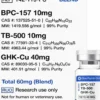
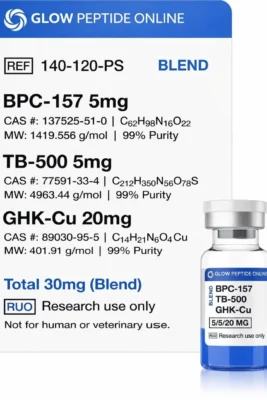
BPC-157, TB-500, GHK-Cu (Glow Blend) 30mg
£70.00
YOUR ORDER COMES WITH;
-
30mg of BPC-157, TB-500, GHK-Cu (Glow Blend)
-
FREE: Bacteriostatic Water (30ml), Sterile Syringes (1ml & 3ml, various gauges), and Alcohol Swabs
-
DOSING SCHEDULE: Comprehensive laboratory administration protocol for research models
-
USAGE INSTRUCTIONS: Detailed reconstitution guide, storage parameters, and handling procedures
-
A COPY OF LAB RESULTS: Certificate of Analysis (CoA) confirming potency, purity, and sterility
How I Mastered How to Reconstitute Glow Peptide Safely
I first discovered glow peptide and immediately wanted to understand how to reconstitute glow peptide and every detail about it. My main focus became learning how to reconstitute glow peptide in a way that preserves its potency and purity. What began as a general interest in peptides for wellness and beauty quickly became more specific once I realized that glow peptide—often referred to as a growth hormone–releasing peptide—combines BPC-157, TB-500, and GHK-Cu. Knowing this unique blend was involved, it was clear that proper reconstitution would be essential for achieving the best possible results.
I soon learned that glow peptide typically comes in a freeze‑dried powder form, designed to keep its active components stable over long periods. When stored correctly, this powdered version can maintain its integrity for many months or even years. The real challenge, however, started once I brought the vial home. The way you dissolve and handle the powder plays a major role in how effective the final solution will be. If you want to understand its broader benefits, feel free to explore more at glow peptide benefits.
Understand why reconstitution matters
 Before diving into the exact steps of dissolving this specialized powder, it’s important to understand why reconstitution is so critical. During freeze‑drying, moisture is removed to dramatically extend shelf life, but that also means the product must be brought back to a usable state before injection. When I was ready to use it, I had to add a sterile liquid—typically bacteriostatic water or sterile water—to turn the peptide back into an injectable solution.
Done correctly, how to reconstitute glow peptide helps maintain the peptide’s integrity and supports proper absorption once administered. If the process is rushed or handled carelessly, contaminants can be introduced or the peptide can start to break down, reducing its effectiveness. Over time, I came to appreciate that:
- Bacteriostatic water, which contains 0.9% benzyl alcohol, helps slow the growth of bacteria and keeps the solution usable for longer.
- Gentle handling—swirling the vial instead of shaking it—supports the peptide’s delicate structure and reduces the risk of damage.
- Limiting exposure to air and light also helps minimize oxidation, which can weaken the peptide over time.
Because glow peptide is designed to influence growth hormone secretion, even a small error in preparation can undermine how it works. That’s why I follow a strict, consistent routine every time I open and mix a new vial.
Learn how to reconstitute glow peptide
Refining how to safely reconstitute glow peptide took me several attempts to get right. After reviewing updated 2025 guidelines and consulting with healthcare professionals, I developed a clear, dependable step-by-step method. Here’s the process I now follow:
Step 1. Gather materials
-
Glow peptide vial containing the freeze-dried powder
-
Bacteriostatic water (or sterile water, as directed)
-
1 mL syringe for accurate measurement
-
Antiseptic wipes for cleaning vial tops and injection sites
-
Disposable gloves (optional, but recommended to support sterility)
Step 2. Clean the vial
I start by thoroughly cleaning the vial’s rubber stopper with an antiseptic wipe. Even though glow peptide is usually packaged in a sealed vial, I still take this extra precaution to keep the preparation area as clean and hygienic as possible.
Step 3. Introduce the diluent
Using a 1 mL syringe, I draw up the required amount of bacteriostatic water. In many protocols, this might be around 1.5 mL for a vial that contains 5 mg BPC-157, 10 mg TB-500, and 27 mg GHK-Cu, though I always follow the most current guidance provided. Once measured, I tilt the vial slightly and slowly let the water run down the inner wall rather than spraying it directly onto the powder, which helps protect the peptide structure and minimizes foaming.
Step 4. Gently swirl
Gently swirl or tilt the vial until all of the powder has completely dissolved into a clear solution. This usually only takes a few seconds to about a minute. I avoid vigorous shaking because it can potentially damage the delicate peptide chains, so I stay especially careful at this stage to protect the integrity of the glow peptide.
Step 5. Verify clarity
Once the solution looks clear and there are no visible particles, I mark the vial with the reconstitution date. This simple step makes it easy to track how long the glow peptide has been stored in the refrigerator and helps me stay within safe use timelines.
At this point, I know the glow peptide is ready for use. For anyone curious about how much to inject, see how to dose glow peptide for more details.
Store reconstituted peptides safely
It’s easy to assume that once the powder is dissolved, the hard work is done. However, reconstituted peptides can degrade quickly if not stored properly. Here’s how I handle that:
-
I immediately recap the vial and store it in the refrigerator at around 4°C for optimal stability.
-
Each day, I remove it briefly to measure my dose—typically 0.1 mL (10 units) for daily subcutaneous injections, as recommended.
-
I rotate injection sites (abdomen, thigh, upper arm) to prevent irritation and ensure consistent absorption. For more tips, check out glow peptide injection.
-
Even for higher doses within the recommended 100–200 microgram daily range, I maintain the same strict sterile protocol.
I also steer clear of repeatedly freezing and thawing the reconstituted peptide, since that process can degrade its structure. Typically, I adhere to a 30-day protocol of daily dosing, followed by a 15-day break before considering the next cycle.
Consider final reflections
Mastering how to reconstitute glow peptide has been key to getting the most from its potential benefits. By storing the freeze-dried vial at low temperatures and slowly adding bacteriostatic water, I’ve learned that each careful step directly affects the final results. I’ve noticed that strict attention to sterility, solution clarity, and temperature control has a real impact on how my body responds to the peptide over time.
If you’re considering glow peptide, I recommend sourcing it from trusted suppliers, measuring precisely at every step, and sticking to established guidelines. This approach has given me greater confidence while minimizing risks around peptide stability or contamination. For more details, see glow peptide reconstitution.
Overall, this journey has taught me that in the world of peptides, details matter. I hope my insights help you stay safe, extend the shelf life of your glow peptide, and get consistent results with every injection.
Be the first to review “BPC-157, TB-500, GHK-Cu (Glow Blend) 30mg”
Related products
Uncategorized
Reviews
There are no reviews yet.